Enterprise Platforms
Beyond methodologies, Optimus Talentum develops platforms for agent governance, the control point on every agent call, delivery governance, and the register of people, hours, and cost on a project.
OT AMP™ — Enterprise AI Agent Governance Platform
OT AMP™ is the control plane for enterprise AI agent deployment. As organizations move from pilot AI to production agent orchestration, OT AMP™ provides the governance layer that ensures agents operate within defined boundaries.
Agent Registry
Centralized catalog of all AI agents — capabilities, permissions, ownership.
Lifecycle Management
Governed deployment, versioning, retirement, and rollback.
Routing and Orchestration
Intelligent task routing based on capability, availability, and authorization.
Access Boundaries
Fine-grained control over data, systems, and actions per agent.
Model Abstraction
Decouples agent logic from model providers — enables model switching without rearchitecture.
Audit Trail
Complete, immutable record of all agent actions and decisions.
OT AMP™ operationalizes the Horizon 2 mandate of OT Dual-Horizon™.
OT Gateway™ — Control Point for Every Agent Call
OT Gateway™ sits in the path of agent traffic, wherever the agents run. Every call is identified, allowed or refused, and recorded. The customer keeps the environment.
Models, tool servers, and other agents are in the same path. A call from an agent to a model, from an agent to a tool, or from one agent to another is handled the same way. OT AMP™ is the governance. OT Gateway™ is the control point that carries it out.
A catalog of every agent
- Each agent is listed with an owner, a purpose, and a version.
- Agents that nobody registered are found and can be isolated.
- An agent’s path can be reconstructed from the decision, through the tool, to the data.
An identity that is not a shared key
- Each agent receives a cryptographic identity from the enterprise directory or from a workload identity.
- Long-lived API keys are replaced with short-lived credentials, scoped to the call and rotated on their own.
- A multi-agent workflow gets a fresh credential at each hop, so one token is not passed along the chain.
A decision before the call leaves
- One policy covers models, tool servers, and other agents. The default is deny.
- The policy is applied in the path of the call, before the action, and the agent’s own code is left unchanged.
- An agent can be limited to a specific model, tool server, API, or tool.
- The same control covers prompt abuse, rate limits, guardrails, budgets, and spend limits.
- A high-stakes call can wait for a person. An agent that misbehaves can be cut off at once.
The posture of the agent
- Each agent is checked, continuously, against a baseline.
- Drift and permissions that are wider than the job are surfaced as they appear.
- Each agent can run inside a constrained environment, limited to the operations it is allowed.
- The record maps to privacy, health, security-operations, and financial-services requirements.
- Weak configuration is probed on an ongoing basis, not only at deployment.
Behavior the agent cannot edit
- What the agent does is watched at a layer the agent cannot alter, including the calls it makes and the data it touches.
- Credential theft and movement across the environment are caught even when the call itself was allowed.
- The result is a forensic record of what the agent did, not only what policy said it could do.
A console, and an assistant that can run it
- Inventory, policy, traffic between agents, audit search, and traces sit in one console.
- The same actions can be driven from an assistant: register an agent, ask which agents can reach a tool server, or see what the policy changed.
OT Pace™ — Enterprise Delivery Governance Platform
A governance platform for disciplined delivery across distributed contractor and partner ecosystems, enabling time accountability, utilization visibility, and enforcement of delivery standards.
Contractor Governance
Onboarding, compliance, rate structures, engagement terms.
Delivery Accountability
Time tracking, task assignment, and deliverable tracking tied to methodology milestones.
Utilization Visibility
Real-time visibility into resource utilization across teams, engagements, and geographies.
Margin Discipline
Cost tracking and margin analysis at engagement, team, and individual level.
Governance Enforcement
Automated enforcement of delivery standards, approval workflows, and escalation protocols.
OT Pace™ ensures that operational discipline across licensed delivery partners matches architectural discipline in design.
OT Register™ — Project Time and Cost
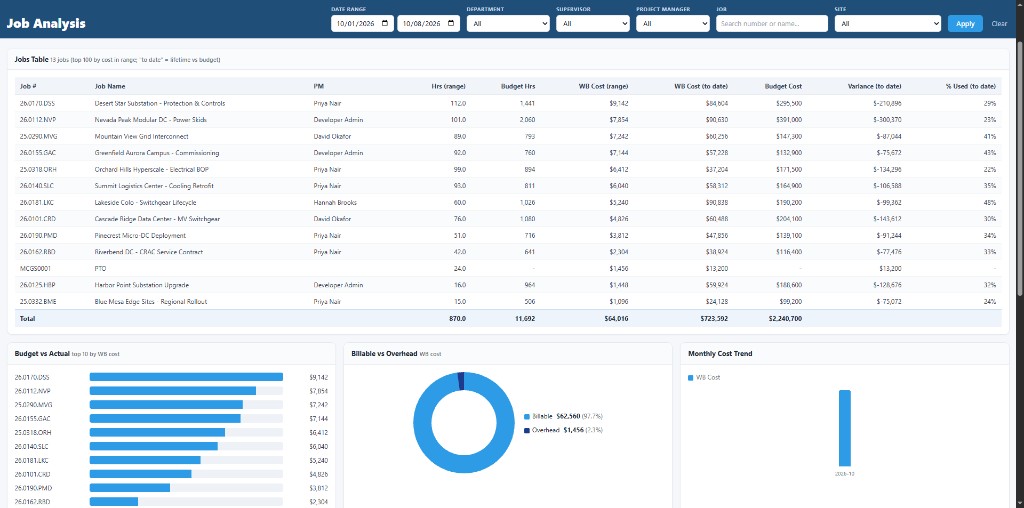
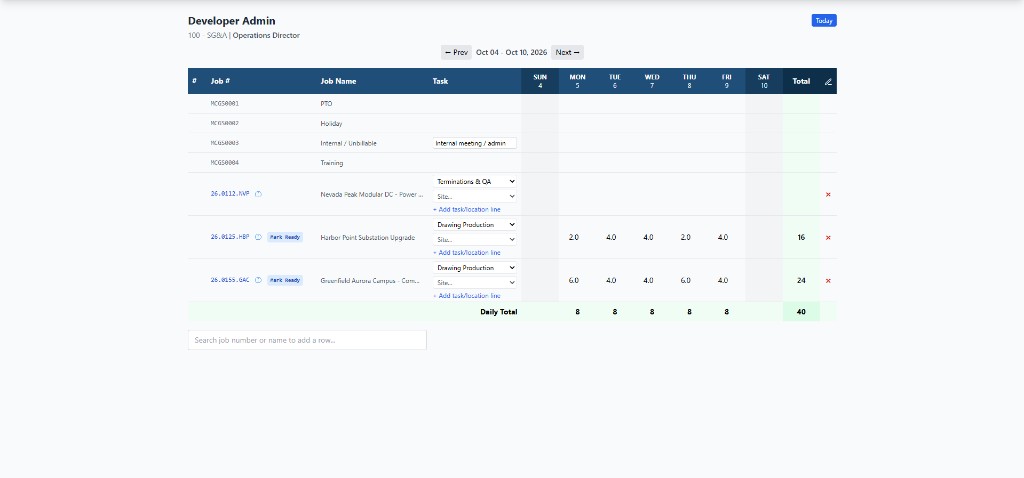
OT Register™ is where a person posts the week, and where the job is read against its budget. Hours go to a job and a task. Cost is compared with the budget in hours and in dollars, including what is billable and what is overhead.
Weekly timesheet
A person enters hours by day, job, and task, and sees the daily total for the week.
Hours against the budget
Each job shows hours in the period next to budget hours.
Cost, variance, and percent used
Work-breakdown cost to date sits beside budget cost, with the variance and the percent of budget used.
Billable and overhead
Cost in the period splits into billable work and overhead.
Who is on the job
Each job shows its project manager. Each person has a weekly sheet of the jobs they touched.
Filter the work
Date range, department, supervisor, project manager, job, and site.
OT Register™ is the working record. OT Pace™ is the governance around delivery.